Showing posts with label miniatures games. Show all posts

Wednesday, May 27, 2015

Huzzah Day 2- Pulp Alley

I've been fascinated by pulp or adventure style miniatures games for some time now. The theme is always alluring enough- play a minis game as Dr. Who, a member of Danger 5, or a Cthulhu investigator. At the same time I always wonder if the experience is really going to be close to the ideal, or if it's better just to role play.

On Saturday afternoon I got a chance to play a pirate themed game using the Pulp Alley rules. These had been favorably reviewed on Meeples and Miniatures and I was excited to give them a try. In a sense it would also be interesting to compare the game to the Muskets and Tomahawks game, which was skirmish wargaming but with a good taste of adventure gaming as well.

Marines Face a Scary Hill
The game was called St. Pomme de Terre- the Governor's Daughter. My faction represented royal troops trying to retrieve the governor's daughter from a band of pirates. We were to approach the pirate lair in a ship and a longboat and then travel through a swamp or along the docks and eventually defeat the pirates. Along the way we could earn victory points for capturing treasure, defeating enemies, and hopefully rescuing the kidnapped woman.

On a positive side the game was well thought out and a lot of fun. There were swamp creatures, colliding ships, cannon fire, people falling off of masts, sword fights, gun fights, and foggy graveyards. The royals got off to a miserably slow start and barely made their way across half of the terrain due to falling down hills, getting trapped in swamps, and probably being too cautious. Eventually we ended up in a mammoth brawl on the outskirts of town but the sun was at that point setting and our mission a  bit of a failure. Still, both pirates and royals had a good time.

Hill 1, Marines 0
That being said, I can't say I'm sold on the rules. There is ten times as much detail regarding the figures as there is in Muskets and Tomahawks. That translates into a game that's about ten times slower to play. Each figure may have several unique abilities and you have to remember them, as well as watch for your opponent's secret traits. Plus you can play cards that inconvenience or sabotage your opponent's play. The result is, again, a slowish game.

It's also noteworthy that I felt like Muskets had as much or more of a narrative through the game. My vaguely defined Indian party had a wild adventure without detailed special rules and characteristics. The narrative flowed from the game play itself. In the Pulp Alley game I spent quite a lot of energy trying to remember which figure was good in a fistfight, which was a sharpshooter, and which was hard to hit. In the end keeping track of all that was more of a distraction than a game enhancement.

In the end, though, my critique is with the rules, not the game and the people who ran it. I'd certainly play it again and they did a bang-up job setting up the adventure. But I didn't walk away wanting to buy the rules.


Tuesday, May 19, 2015

Huzzah Day 2- Fletcher Pratt Naval Warfare Game

USS Baltimore!
This year I had another chance to play the amazing Fletcher Pratt Naval game, run again by Wes Decampos. This game takes place in an entire ballroom and is played on the floor with large scale ship models. It's a complete spectacle. What makes this yearly event so enjoyable, however, is that Wes runs a tight game. He supplies a pile of handy charts, he explains the rules quickly and clearly, and he's done this enough times to avoid rules lawyering, complaints, quibbles, and whines.

In this scenario a convoy of Japanese ships are attempting to land troops on Guadalcanal. The Americans must intercept them. As a twist the encounter takes place at night so spotting is difficult and some of the engagements may take place at unusually close range.

The modified Fletcher Pratt rules are simple. Ships move, maneuver, and then fire. Each player picks a target and then guesses the range, often up to twenty feet. Then Wes checks the actual ranges and if you guess correctly you inflict damage on the target. Larger ships can only be damaged by larger guns but every ship is vulnerable to torpedoes.

My goals for the game were twofold. Based on prior years I vowed not to collide with a friendly ship and not to collide with torpedoes. I would earn bonus points if I could avoid being sunk outright.

The game unfolded and moved along at a nice pace. I commanded a heavy cruiser, the Baltimore. A cluster of American destroyers were deluged with torpedoes and went down pretty quickly. I engaged a nearby Japanese light cruiser and scored some lucky hits while avoiding his torpedo fire. Just to mix it up I fired at and scored one hit on the Japanese battleship which scratched some paint. That was enough to teach me to stick to light and heavy cruisers for the rest of the game. It felt a little cheesy to take on smaller ships but that's probably what would have happened historically. The light cruiser's captain was a good sport at least!

At the end of the game the Americans held the field. Or waves. I had avoided collisions of all sorts and was still afloat. It had been great fun to move big toy ships around a huge ballroom and I'll do my best to play again next year.


Huzzah 2015, Day 1


 The Huzzah wargame convention in Portland, Maine, has been a personal gaming highlight for years. The players attending are typically fun and friendly, the games usually look terrific and the rules are interesting. This year was possibly the most fun yet.

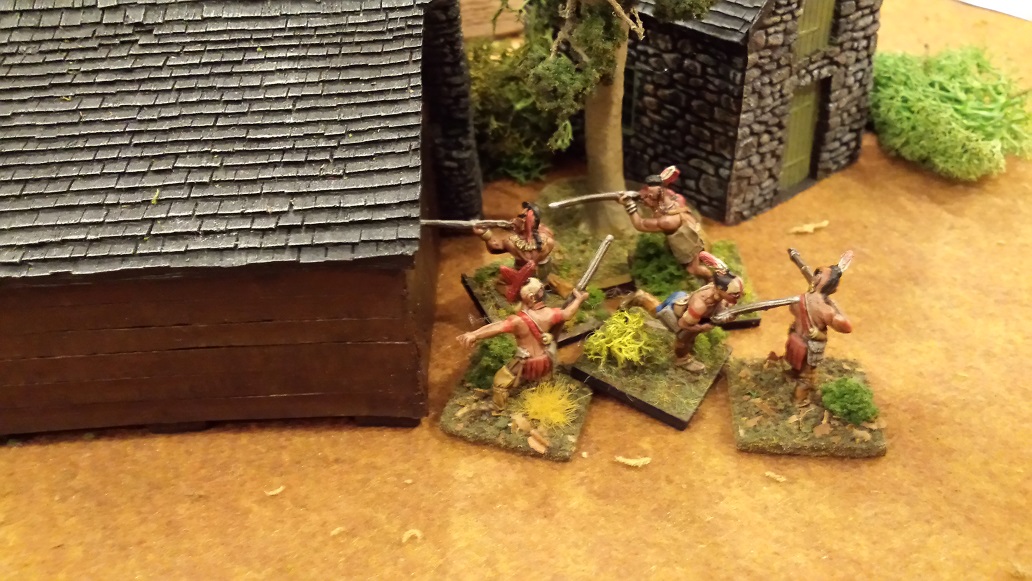
The first game I played was Bloody Tomahawks- Supplies for the Outpost. This was a scenario for the popular Muskets and Tomahawks rule system and was run by Earl Richards. I was curious to give these rules a try as our club has started assembling some troops for North American combat, circa King Phillip's War and onwards.

In the scenario a British colonial outpost is awaiting supplies. The French are trying to intercept the convoy. Both sides have local irregulars and Indians assisting. I was assigned a party of Indians fighting for the French.

The game ran fast and smoothly. We needed maybe ten minutes to learn the rules and there were few questions after that. Parties are activated by a card draw and then have a number of actions. Different factions may have different movement rates, firearm skills, and ability to shrug off averse events. In game play the British regulars were slow as molasses but deadly at ranged fire. The colonial rangers were faster and could move through the woods easily. My Indians were exceptionally nimble but prone to break away if the suffered too many casualties.

Burning Down the House
In terms of narrative and play we had a terrific time. The regulars confined themselves to open fields and roads. The Indians and rangers dashed through the woods and tried to make the most of their mobility. My troops were able to run to the town and start firing houses but I unwisely led them into the open and they disintegrated under fire from three directions.

On the whole the game was a lot of fun, both as a simulation and as a quasi-role playing adventure game. The rules were intuitive and quick to teach. At the same time there was some nuance to each faction and you had to play carefully to accomplish your goals. We had six or so players and everyone stayed engaged and entertained.  I'm excited to have a use for my Wargames Factory Indians and looking forward to playing some Muskets and Tomahawks in Malden soon.

Monday, May 4, 2015

Ancients Rules Update- To the Strongest!

Not long ago the club was having its' monthly DBA ancients game day. Readers may already be aware that DBA is an old and popular set of game rules for playing out ancient and medieval battles. During the games there were several tense and unpleasant moments, however, in which people had trouble agreeing on exactly how the small miniature figures could move on the table. At one point things almost grew ugly.

Let's ignore the implications regarding grown men who might get angry about a game involving toy soldiers. Each genre seems to have rules that cause arguments. World War 2 games break down when dealing with assaults and air support. Ancient battles games suffer when describing charging and movement. You may be playing on a six foot long table but a millimeter's difference in placement can have huge implications as to who wins a battle. This dynamic is one of the things that author Simon Miller attempted to address with his To The Strongest! rules.

To the Strongest! (TTS) is a set of rules that allow you to play out ancient and medieval battles on a tabletop. You need two armies made up of eight or more units. The play takes place on a board formed from a grid of squares measuring 8 x 12. The square grid removes any issues regarding placement on the battlefield. Units are clearly "here" and can clearly and unambiguously move "there."

TTS has other novel game mechanics. Anything involving chance is resolved using ordinary playing cards. Success at some task is accomplished by drawing a card, The harder the task, the higher a card you need. In our playtesting we found this speeds up the game more than you'd expect. Dice are fun. They also fall from the table, roll around, hit things, get stuck under terrain pieces and generally eat up a lot of time to use. Flipping a card is the same as rolling a ten sided die, just a lot quicker.

Warmaster 10mm Back on the Table!
TTS has several elements that will be familiar to miniature gamers. Units on the table can be represented in any fashion- the exact number of figures on a stand doesn't matter. You could use wooden tiles to represent units, or German flats, or even paper cutouts. For our playtest games we used my old 10mm Warmaster Ancients stands. There are also familiar damage saves, overall morale levels, and a need to use leaders for important moments in the battle.

My overall take on the game was very positive. The mechanics themselves practically fly along. I taught an eight year old how to play in a few minutes and rules checks were minimal. That being said, playing well demands some thought. You are rewarded to keeping a good battle line, for proper use of skirmishers, for having a second line and some reserves. You need to manage light troops as they are helpful but fragile. Leaders are given simple rules with some subtle implications that cause Roman armies to behave quite differently from Briton ones, for example. There is a push-your-luck mechanic to giving orders but you will always get to move your troops, unlike some turns of Hail Caeser or DBA for example. Finally, the game works one on one or with larger groups.


I've been looking lately for games that are fun, challenging, and drama free. For my World War 2 needs Chain of Command has hit the spot. To the Strongest! looks to be a playable and fun ancients rules set. It's simple enough to teach to kids but deep enough to give a challenging game to experienced players. The rules are well written, packed with great diagrams and photos, and absolutely priced to move. I'd recommend taking a look.

Sunday, November 30, 2014

Vehicle Fun Part Two


The Normandy campaign for Chain of Command is moving along at a spunky pace and the Americans I command get some vehicle options. I like vehicles, especially bizarre and obscure ones. I like early war desert light tanks and the Soviets have a real talent for putting motors in things (I'm talking about you,  Aerosani!). Imagine my dismay, then, to discover that the Americans had essentially four vehicles. Trucks and halftracks, jeeps, Sherman tanks, and tank destroyers. Granted there are a few oddball creations like the M-8 and early on the Grant and M-5 are active but even so, American vehicles are just plain dull.

Resigned to equipping my fellows with Shermans and tank destroyers I picked up a pair of Armourfast models. Armourfast makes affordable models and the range is fairly decent. My initial impression when I unboxed the kit was neutral. It certainly didn't look too complex, rather the opposite. That initial impression was borne out as the construction commenced. The kit is slightly less complex than the Pegasus models and is really lacking in detail. Further, it had a good number of fit issues and I found myself puttying up a lot of spaces. Finally, the sprues attach at points that are highly visible, meaning that if you detach them carelessly you end up with big, visible gashes in the model.

Fine
I finished up a Sherman and M-10. The models are fine. Not fine like fine dining but fine like not terrible. They build fast and the price is right but if you're putting something on the table it may as well look special. And if I want simple, fast builds I think I'll go back to Pegasus.

Vehicle Fun Part One

My friend John and I are in the midst of a Chain of Command campaign set in Normandy and I've been slowly adding to my forces. John started in 1/72 scale and amassed a huge collection of great looking scenery so I went along and started up a whole new scale to collect.

Having set up a decent base of figures I turned to vehicles. There seem to be a few choices to work with. There are a number of "toy soldier" style manufacturers, a huge number of "plastic model" style sources, and finally die cast vehicles. I picked up some Plastic Soldier Company tanks, some Armourcast vehicles, and then looked for some 1/72 plastic models. I needed some late war Normandy gear but also some armor suitable for the Winter War between Finland and the Soviet Union. Imagine my surprise when I stumbled into Hobbies With a Twist in Concord, New Hampshire, and found a huge pile of 1/72 obscure Russian early war vehicles. On sale!

The immediate and obvious drawback to eastern European plastic models is that the engineers have excessive confidence in my ability to manipulate and glue tiny 2mm bits and bobs. Does the tank have a knob of some sort? Then clearly it needs to be modeled! But once my initial dismay at the array of tiny soft plastic pieces dissipated I was struck by how easily the model fell together. The fit was smooth and the instructions generally clear. I needed to scratch build one section that was ruined through my doing, and I made a machine gun barrel out of syringe because the plastic barrel would have a lifespan of minutes. Otherwise the model was a real pleasure to assemble.

Early War Wunder Weapon
I'm working on another Soviet flame tank by the same manufacturer. It's going even better than the first. Once the initial tiny piece shock goes away these kits are great fun.


Wednesday, October 8, 2014

Hobby Fun with a Seven Year Old

Up to now letting my son "help" with hobby time has been less than satisfying. Unlike other forms of helping where something might actually get somewhat partially done he's just too young to paint small minis or do terrain. Much to his happiness and my pride that has now changed.

My 1/72 scale Russians needed some light armored vehicles and since I find armored cars to be super cool looking anyway I picked up some Pegasus BA-6's. Two vehicles is less that 15$ so it seemed reasonable. When I started cleaning the sprues my son asked to help and so each of us put one vehicle together.

My past experience with plastic models has demonstrated that engineering is everything. A well designed kit almost falls together with minimal filing and no forcing or prying. On the other hand, a badly designed kit Almost fits and that almost-y quality is a source of terrible frustration. Soon there's putty everywhere, dried glue on your fingers, and a model that looks almost decent.

Happily the Pegasus kit is very well designed. The instructions are clear, the pieces all fit nicely, and assembly is just complex enough to be interesting but certainly simple enough for a seven year old. The result- a nice looking vehicle! Painting time next, but I'll be looking at more Pegasus kits. Especially ones that have two models in the box!

Space Hulk Reprinted, Special Edition Acquired

Genestealers!
Fans of science fiction gaming are by now aware that the classic Games Workshop product Space Hulk has been reprinted for the third time. The game features outnumbered space marines trying to reach some goal in a labyrinthine spacecraft while under attack from waves of alien genestealers. Space Hulk was a formative game for many, for me the early computer version was hugely exciting. More recently a version with cards has been released. This game, Death Angel, is terrifically designed and I've played it often.

I did muse about shelling in the $100 for the fourth edition but luckily my son preempted me by creating the special edition himself. A pile of legos, some pen and paper, and you're ready to roll. To be sure, I drew the marines but he did a credible job on the genestealers and designed to ship itself. We both contributed sound effects and cries of "Avenge me brothers," and "my bolter is jammed!"

Lego Space Hulk is still plenty fun- we played with a mishmash of Death Angel and ios Space Hulk rules. Highly recommended and you end up saving $99.80!

More Plastic Soldiers

We've been playing Chain of Command lately and one of the more active players has a large 1/72 scale set of armies. I have Second World War armies in four other scales and it seemed a bit much to invest in a fifth but the he game me a few boxes of Pegasus figures so of course I had to paint them up.

The Pegasus figures are plastic and come on sprues. The manufacture and sculpting process requires most of the figures to have a separate arm which needs to be glued on. I started by washing the sprues in order to remove the oils that coat all plastics. I failed to do to proper job on that and later on my painting efforts would be a huge pain.

The figures glued together just perfectly. I didn't have to do any adjusting or customizing and the resulting pieces looked great. Considering some of the hoops I've had to jump through with Infinity or Warmachine figures that was a treat.

The painting was initially a horrible nightmare and entirely my fault. Plastics come coated with an oil and if you don't scrub the heck out of them the primer will not stick and neither will the paint and the result is just nasty. And I've only been doing this for forty years...

The figures on the whole are quite nice. They are much more slender than the other 1/72 minis on the market so I wouldn't try mixing in Plastic Soldier Company figures into the same unit. These are all designed for winter gaming so for summer I'll probably use the chunkier models from other sources, just to have some freedom to mix and match. Still, one or two boxes of these and a pair of vehicles and I'm ready to go with winter Eastern Front Chain of Command. Not too bad.

Sunday, October 5, 2014

Chain of Command- Good Platoon Level Gaming

Over the last few weeks we've been playing a new set of platoon level World War Two rules at the club called Chain of Command. They're published by Too Fat Lardies and bring with them some of the best and worst qualities that the Lardies usually deliver.

In a game of CoC each player is likely to command a platoon with some support. The basic game may include a single vehicle and some low level artillery. A game takes a few hours to play. In this there's a lot to like. Setup is fast and you don't need a huge collection of models to play. Through the course of the game each player rolls a set of dice and then uses the results to activate teams and squads. If you roll a "2," for example, you can activate a squad to
do something. Rolling a "3" let's you activate a leader who can cause a small cascade of events to occur. Generally speaking you'll have the chance to do Something useful each turn, but the dice add an element of chance. At the same time forces with more and better leaders are likely to do more things, more often, which is appropriate for this level of game.

Firing and combat results are straightforward enough, with figures delivering a number of firing dice and then attempting to roll a target number or higher. Successful firing can cause outright deaths or simply weigh down the squad with "shock," which slows movement and makes firing less effective. Inflict enough shock and casualties and the unit will break.

CoC includes a few novel elements (as is typical for a Lardies game). The activation mechanism is exciting, a little "gamey," but adds some tense tactical choice making. There is a pre-game patrol segment in which players vie for deployment options that is also exciting and challenging. The shock mechanism is effective and overall the game flows well.

On the downside the rules could really use some editing. I don't know why but I constantly struggle to make sense of Too Fat Lardies rule books. The games themselves play quite nicely but I don't think I've ever learned the rules from the book itself- it's always been from having another person teach me.

On the whole, though, CoC is a very fun game and we've been playing the heck out of it. The investment to play is very low, especially if you play in 15mm or 1/72 scale. The games go fast and feel somehow more historical than the Bolt Action games. I think the only caveat is the oddly mysterious rule book. If you can get through that you have a very nice set of platoon level rules.

Thursday, May 1, 2014

Final Charlie Don't Surf Playtest

I had one more chance to test the game last weekend with trained wargamers this time. The good news is that after a few minutes of play the game flowed pretty well without my constant direction. One thing you look for in a convention game is to have the GM disappear into the background and let the players concentrate on having fun. So that was good.

I continue to be very happy with the 6mm figures. The main drawback to them is that NVA and American uniforms are pretty identical at that scale. I'm going to have to give them all banners of some sort.

The battle of Hoa Tan was a huge success for the Americans, with high NVA losses and (relatively) few US casualties. We found that Charlie Don't Surf is accurate enough in that this scenario is terribly hard for the NVA players. They are outnumbered and outgunned from the start and ambushes and snipers just don't slow down the American steamroller enough to make a difference. I hate to meddle with the historical order of battle but to make the game fun for all the players I'll be cutting down on the American troops.

The consensus in the end is that the rules are decent, the game flows quickly enough once you have played a turn or two, and that the terrain is almost con-ready. Compared to my usual games which appear at Huzzah with the paint still drying that's not too shabby at all.

Wednesday, April 9, 2014

Another Charlie Don't Surf Playtest

Last night I inflicted miniatures gaming upon my board gaming group at Myriad Games in Salem. Suffice it to say that they were Very Good Sports and that I completely botched any rules explanations and probably left them mystified.

That being said, what lessons were learned?

Did I mention those people were indeed Very Good Sports as well as being Inhumanly Patient? If you like board games and you're in the Salem, NH area then you should absolutely pay the store a visit.

Renee's ambushing troops accumulate some shock
Secondly, while I feel I'm not unclever, I'm still struggling with the TooFatLardies rules. Charlie Don't Surf is not complex in its' foundation but the basic structure begins to fray when various details are addressed. So, for example, squads and platoons move and fire easily enough. The rules concerning them are intuitive in that once you've moved one squad you know the system. Unfortunately there is a somewhat different system for attack helicopters. And snipers. And antiaircraft fire. And artillery. Not vastly different, but different enough that you need to know them as addition sets of rules.

And then there are the modifiers. I understand the justification for modifying die rolls but there are a Lot of modifiers in Charlie Don't Surf. I ended up just ignoring a lot of them during the game and setting an arbitrary target for success in order to speed the game up and cut down on paper cuts as I flipped through the rules.

Helicopter stand in background
So beyond needing a bit of streamlining the rules are still basically sound and do create a nicely realistic Viet Nam conflict experience. The NVA are outgunned but with snipers and bunkers have the ability to slow and blunt the American advance. They do need to stay mobile. If the Americans can pin the NVA in place that's the end of the battle- and that's very period appropriate.

The terrain was also tweaked a bit and is getting closer to where I want it. I've gone through two bottles of Fray Block as I cut up dozens of tiny rice paddies out of towel material. I'm going to need a few more before I'm done.

Hopefully I'll get one more playtest in before Huzzah. Not with the Myriad folks though, they have done their part!


Monday, March 10, 2014

Charlie Don't Surf After Action Report

Last weekend we got a chance to run through the Battle of Hoa Tan using the Charlie Don't Surf rules. For this game we had four platoons of Americans assault the South of the village and the adjacent terraced rice paddies.

I was able to obtain some very nice maps from a Charlie Troop website and it's webmaster, who kindly sent me a copy of the real battle's after action report. These allowed us to have a good order of battle and orient the game. The map shows how two of the platoons proceeded. In our game we also included the other two platoons and told the players they had to sweep the village and also relieve a reaction force on the paddies.

I had envisioned the Americans splitting into two groups to tackle the village and paddies simultaneously. I also imagined the NVA setting up bunkers and snipers to blunt the force of the American advance early on. Of course, neither happened. The Americans swept up the Eastern half of the board en masse and the NVA player committed whole platoons piecemeal into face to face firefights. The encounter was a bit of a rout for the NVA, even more so than in history.

Maneuver with Blinds
Largely I blame my game parameters for the scope of the rout. Next time I'll mandate that the American players split their forces as was done historically. I'm also going to take the NVA players aside and offer some tips that the actual participants would have been aware of. A time limit may also encourage the American player to move more quickly and take some risks.

Captain Shrader in the Air
On the whole we were happy with the rules. They are fundamentally sound. Full strength American squads will completely outgun their opponents in a face to face encounter. The NVA and VC can avoid such encounters and concentrate on ambush, sniping, and fire from cover. Helicopters can be very effective but become bullet magnets and if they are shot down get the NVA huge amounts of political victory points. Overall the rules reward historically accurate behaviour. Further, the political victory points encourage the Americans to limit casualties and evacuate the wounded whenever possible.

My table setup was a fair success as a test of concept. I'll need to mark out field boundaries better and set up the hedges with more space in between. The trees with pins at their bases stood up perfectly. That technique is going to be heavily used in the future. The board now needs to be coloured in varying shades of green, flooded rice paddies added, and the field boundaries marked.  I was able to find some amazing colour photos taken before the battle and they have been invaluable in designing the board.

Perhaps the only real criticism to the event is in relation to how the rules are written. As with many of the Too Fat Lardies products, the concepts are sound but the writing and editing lend themselves to long minutes trying to sort out specifics. I think these rules are the best on the market for the period and scale and I would recommend them to anyone with an interest, but I do wish TFL would bring in an editor.That aside, though, I'm looking forward to finishing the terrain and giving the game another go.

Tuesday, February 25, 2014

Vietnam Miniatures Rundown

I'm going to be running several games at Huzzah using 15mm miniatures. At the moment there are a number of good sources of figures but postage and unexpected sales have propelled me towards a few brands.

A local store ran a huge sale on Battlefront miniatures recently following the demise of Flames of War at their site. I picked up some NVA regulars and American airmobile infantry. The American troops are decent. The pack has a good variety of poses and the sculpts are characterful, especially considering the scale. I sped through the painting process in order to generate a platoon quickly and with that level of care the minis still end up looking pretty good.

The NVA regulars, on the other hand, are embarrassing. There's far more flash than a 15mm figure from a major player should have. The poses are odd or unrealistic. Some of the body parts are bizarrely proportioned. And the insignia on the helmets are scaled to look like miner's headlamps. I think these were early works in the line but Battlefront should have pulled them and replaced them with something less horrible.

Finally, I picked up some Battle Honours/Quality Castings 15mm VC. These figures are smaller than the Battlefront types and don't attempt any real facial features. They are also a little more stylized in their poses and remind me of the Peter Pig house style. That being said, they do the job well and look good on the table. I'll be looking for more of these, especially for NVA and VC troops, who should be slighter than their American and ANZAC opponents.

I would have liked to use Peter Pig figures but the postage from the UK is crippling, especially if I'm going to be fielding a company per side. Brookhurst Hobbies carries that line as well but it remains expensive. I will use Peter Pig for civilians as their selection is better than any others. Flashpoint Miniatures carries a Vietnam line but their military figures seem no better than Battlefront's and their civilian selection strays away from straightforward farmers and bystanders.


Thursday, February 13, 2014

Search and Destroy for Huzzah!

As both my readers will recall I recently ran a game of Charlie Company with the idea of either starting a campaign or running a game at Huzzah!, or both. That project lurched a bit as I tried to find some way of making squad level action relate to Vietnam specifically. Gaming the period really seems to beg for an entire company being present. With that in mind I started looking for another rule set.

Search and Destroy was published by SPI in 1975. Gamers of a certain age are now getting misty eyed and remembering flimsy flat plastic boxes, counters, and rules headings arranged in helpful numeric form ("[5.36] Under certain optional rules "Killed" or "Wounded" markers representing..."). Good times. But thanks to the modern magic of the interweb and the folks at Board Game Geek the rules and accompanying articles in Moves magazine are still available.

Search and Destroy is a board game in which each counter represents a single squad. Typically two companies will face off. The goal of the game is to score points- the American scores by collecting hidden caches of weapons and records, and by not being decimated in the process. The NVA player wins if they inflict casualties on the Americans and defend the caches.

Analog Game Tools
The designer took those basic criteria and made them period appropriate. Americans score fully if they can confirm the casualties, either being inflicting them at close range or through after action policing. The Americans score less if the casualties are inflicted through air or artillery, and further, the NVA Get points each time air and artillery are used. In essence, the American player can score a military victory with lavish air and artillery and still lose politically- and politics is the currency for victory in this game.

There are some further design tweaks. The NVA operate in blinds and until they are "searched" the American is unsure whether a counter represents decoys, troops, or peasants. NVA can also "hide" which essentially turns a known unit back into a blind. And as one could imagine killing peasants is politically damaging to either side.

The end result is that the Americans command a huge amount of firepower but have to be cautious in how they use it. The NVA can use hit and run tactics but in the end have to defend or distract to protect their weapons caches. The rules include fixed wing and rotary air, helidrops, antiaircraft fire, interrogations, and medics. I'm looking forward to playtesting them and running the game (hopefully) at Huzzah!.

For more information look on Board game Geek for more reviews, lists of related articles in Moves, and some helpful images. Phil Kosnett's article in Moves #23 is pretty essential, and has some critical errata.

Sunday, January 19, 2014

Charlie Company After Action Report

We ended up playing the two scenarios over roughly two hours, which for wargames is almost lightning fast. The rules themselves are pretty minimal and the players started up with only a brief tutorial.

Battlefront US
The first game was based on Mines and Men. The players start on a road having just taken two mine related casualties. To the left are rice paddies and then a small hamlet. On the right are fields and then a tree line. As the turns progress the players begin to take sniper fire from the tree line and small arms and light machine gun fire from the hamlet. The players need to protect the wounded and deal with the attack.

Quality Castings VC
This game ran smoothly and the players had fun. They got to experiment with mortar fire, medevac, and fire and maneuver. They also got to fire bazookas at hooches and in the end drive an M113 ACAV through the hamlet. The enemy force was VC and more pesky than flat out dangerous. The players did think to avoid driving across the mine-filled field and the outcome matched the historical notes, with organized regulars advancing to the hamlet and vehicles providing the punch required to rout the attackers.

The second game demonstrated some of the difficulties with Viet Nam gaming. The players were tracing a trail up the Ngok Kom Leat range prior to the battles at Dak To. In the scenario the second platoon stumbles into a NVA company and has to pull back in an organized fashion and call in artillery and air support. None of the players had that reflex to pull back and drop supporting fire and so I had to step in and suggest that this might be second nature to soldiers in 1967. The players felt that if their mission was to follow a trail then they should absolutely follow it even as bullets begin to fly. It's striking and reminds one that skills learned in Napoleonic and Second World War gaming may not apply here. They players reluctantly pulled back, weathered two human wave attacks, and then sat back as Company B at hill 823 took the worst of it.

Flashpoint Hooch
The game system as a whole worked well. A squad of Americans has fair firepower but not enough to deal with entrenched enemies. That's appropriate. VC fire causes damage through attrition, NVA fire is more likely to quickly devastate a unit. Air support is quite spectacular but tough to use at close range. IN sum I felt the game design was sound and period appropriate.

My main concern is that to play Viet Nam you either have to think period appropriately or spend several games being decimated until you learn. The latter is probably historically accurate and educational but demoralizing and time consuming. Weekend gamers may not be up for several sessions of calamity even if they learn from it.

Overall we were pleased with the rules and the games. I'm not sure I'd run this with casual gamers but for people with an interest in the period Charlie Company is well done.

Saturday, January 18, 2014

Charlie Company After Action Report

So after some months of painting and planning we had our test run of RAFM's Charlie Company rules. We had a good time and I was happy with the rules.

Initially I had liked these rules for a number of reasons. For one, they are designed to take into account the fact that free world forces rarely saw their opponents. Opposition forces in Charlie Company are identified by muzzle flashes and the miniatures may never appear on the table. Further, I like the fact that opposition forces are run by the game master. The Viet Nam conflict is marked by free world forces searching for targets or being attacked in static bases. If a human player is in charge of NVA or VC units there is really no reason for that player to ever end up in a less than ideal encounter.

I did have some concerns with the rule system. They are based on one player running a squad or platoon. There is some question about the depth of decision making a squad leader would be expected to make. A platoon leader might have more autonomy but it seems like the company is a good level to control in this theater. I also wondered how well the rules would portray the war itself- would they just simulate a postwar/modern battle or would they carry period flavour?

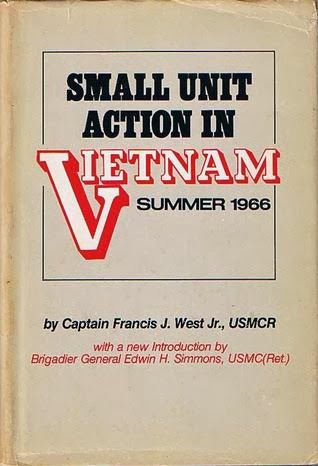
For the purposes of the game I ran two historical encounters. The first was from Small Unit Action in Viet Nam: Summer, 1966, the chapter called Mines and Men.  The second scenario was based on Three Companies at Dak To, from Seven Firefights in Vietnam. This is also available online. The former involves three squads and some armor fending off a weak ambush by Viet Cong. I was hoping to use it to teach basic rules and give the players a sense of the game. The Three Companies game involves a platoon stumbling into an aggressive company of NVA regulars. This was designed to illustrate the value of a quick withdrawal followed by lots of air and artillery support.

Preparing for the games was very satisfying. It's very striking that we engaged in a huge undertaking not too long ago, one with a terrible human and financial cost, and one that changed our country dramatically, and that it's largely forgotten today. People remember The Doors, a band with maybe two good albums to their name, but they're forgotten a ten year war that had mammoth ramifications, both on a macro and a micro scale. The emotional impetus to forget the conflict makes sense, but the success in execution is amazing. And the price paid by vets and by future generations who repeat the war's mistakes is far too high. For the Dak To scenario I was able to find military maps of the area and view it on Google Satellite. There are veterans around us today who fought and sacrificed in those forests (veterans of two sides I might add) and I can say "yeah, I know you did that, I know when, and I know where. That experience isn't forgotten. It's not been erased."

Next- the game and after action.


Friday, December 27, 2013

Year in Review

It's embarrassing that it's been so long since I posted. As they say, "It's my fault but I blame others." Christmas, work, painting. Probably the main culprit is the brain numbing cold and darkness that together make me as productive as a groundhog.

Groundhogs hibernate through the winter in tunnel complexes up to thirty feet in length. You learn many interesting things when you have kids and live in the country.

As I gear up and prepare to knock out a few posts it seems appropriate to look back on 2013 and try and come up with some sort of Best Of list. I like reading other people's lists. Let's give it a go.

Best Miniatures Game
X-Wing Miniatures Game. I do dislike the Star Wars merchandise empire and I resisted buying this game until it was deeply on sale. That being said it's fun, simple, and has a lot of tactical depth. We've played it as straight ahead skirmish combat and with scenarios. It works with three ships on a table and I've played in a game that featured literally dozens of ships. In all cases it's fast and engaging. It feels like a Star Wars space battle. The miniatures are decent quality and (relatively) good value for the fun you'll have with them.

I have really enjoyed the Bolt Action rules for the Second World War. I like how they move the emphasis of the game away from masses of armor and towards infantry maneuver and fire. Further, the rules hit many of the buttons that I look for- they include opportunity fire, they don't encourage rules debates, and they demand a fast moving game. The possible downsides are the expense in starting up (rules, army book, and special dice) and of course the need to have many painted miniatures. Unless of course you have spent the last forty years accumulating painted miniatures. Score.

Best Board Game
Phantom Leader. I have played the heck out of this game over the last year. Phantom Leader is a solitaire game in which you manage a squadron of pilots in the Vietnam conflict over a short or long campaign. In the course of the game you pick targets, assign pilots, arm planes, and then try to navigate through defenses to finish your mission. The game has huge replay value and is quite engaging. I want a solitaire game that I can win occasionally- not never (ahem, Dawn of the Zeds) but enough to bring me back for more. Between replay value and elegance of rules Phantom Leader has been an awesome addition to my collection.

Other than Phantom Leader I can't say any board game has seemed particularly noteworthy this year. Seasons remains entertaining. It's colorful, tactically interesting, and certainly lovely. With the right crowd The Game of Thrones Board Game is terrific fun, but "with the right crowd" is a big caveat. You need to invest some time and some attention to make the game work- not for casual players.

Best Children's Game
King of Tokyo, no question. This game is simple, fast moving, and Exactly deep enough to entertain adults while giving younger players something to think about. It's inexpensive, durable, and colorful. There is some reading involved but in such small amounts that a younger player can simply remember what the cards say. What else? Good for two players, good for more players, has some expansions... Just get it.

I did pick up Mice and Mystics for Christmas. This looks like a lovely game but we haven't played yet. It could be terrible in execution but my guess is that it will be awesome.


Thursday, August 1, 2013

X-Wing Followup

I Promise to Avoid Further Collision
Now that I've played X-Wing a few more times here are some thoughts on the game.

For one, if you're teaching it to people, try and give each new player two ships. X-Wing is fun enough with a single ship to control but it begins to shine when you try and fly in formation. At first you experience non-stop collisions. I collided with asteroids immediately in my first few games. Not after desperate flying or while trying to evade some attacker. Immediately. Turn one. Crash. Now at the time that was pretty embarrassing, especially since there are six small asteroids across a pretty large board. After a few turns, however, the satisfaction of controlling my two ships and not smashing them into things and in fact flying them in cool wing-to-wing formation made my earlier mishaps fade from memory.

Beyond the thrill of competence flying in formation also gives you a clue as to how strategic a game X-Wing is. Certain ships move better in packs. Certain ships work better as scattered skirmishers. You only get a feel for this when you have direct control of more than one ship. So give your new players two ships and maybe hold off on the asteroids.

Not Obscure!
Secondly, Target is now busily putting the base set on clearance. I found a copy for $20 which is an insane bargain. One box will give you a decent few games, two starters and you are set. The downside to this? Explaining what you're looking for to the seventeen year old employee. First he looked up "Ex-Ring," which is sold out. Then after some discussion he looked up the "X-Ring" game, also not in stock. I guess considering the other ways one can misunderstand "X-Wing" things could have gone worse. Still, isn't the X-Wing pretty much common knowledge at this point? It's not like I was asking about the Bugaloos game. Though if there was a Bugaloos miniatures game I would buy it.


Sunday, July 21, 2013

Playing X-Wing

This really was on TV
I'm old. Old enough in this case to have seen Star Wars when it was released. Also old enough to see the Star Wars Christmas Special, Princess Leia in a bikini on Saturday Night Live, and musical stormtroopers singing and dancing on the Donny and Marie Show. From that perspective the present day well oiled multimedia empire of Star Wars just seems implacable, grim, and oddly enough, stodgy. For that reason any new Star Wars product triggers automatic disdain for me. It took some time for Neil in the Meeples and Miniatures podcast to convince me that the X-Wing Miniatures Game might be worth playing.

In a game of X-Wing a player controls one or more miniature ships in a space battle. The players can pilot familiar X-Wings, TIE fighters, and even the Millenium Falcon. For aficionados there are also A-Wings, TIE Advanced, TIE Interceptors, and quite a few other choices. Players choose maneuvers and a simple set of templates act as guides to move the ships around. There are also simple rules for shooting and dodging. If you're inclined you can add in rules for ace pilots, special weapons, and unique skills and abilities.

I've played about ten games of X-Wing by now. Most of them have been with my six year old son and his friends. Those games were pretty fun. The kids understand the game well enough and the play goes smoothly. As a bonus an alert adult can nudge the flow subtly to make sure that every young player miraculously gets to blow something up. It's an amazing coincidence that each child seems to manage to destroy exactly the same number of enemy ships!

I've also played a number of games with other adults. Those were quite a challenge, which is to say I got creamed in every game. Once I stopped slamming into asteroids I did have a good time playing and I was impressed by the game's capacity for tactics and thoughtful play.

On the whole I'm pretty pleased with X-Wing. It can be a fast game, it's suitable for younger players, and it's fun. There is a learning curve and with more play you certainly do become a better pilot. I have noticed that experienced tournament players can get quite intent on developing the ideal squadron but if that level of min-maxing is not your cup of tea it's easy to avoid. On a whole the game has been a good purchase and a lot of fun!